
Updated October 14, 2026. Local Plumbing and Drain Company, plumbing service in Papillion, NE.
When a water heater quits on a weekday morning, there’s no time for a week of research. You need hot water back, and you need to pick what goes in its place. For most Papillion and Omaha-area homes, the tankless vs tank water heater choice comes down to this: keep a storage tank, or switch to a unit that heats water only as you use it.
Both can work well here. The better pick depends on how many people need hot water at the same time, what your gas line and venting can handle, and how hard your water is. Below, we compare cost, hot water supply, energy use, upkeep and install work, using local water numbers along the way.
Direct Answer: A tank water heater costs less up front and stores hot water for bursts of use. A tankless water heater can last longer and never runs out, but its flow rate is capped. Local water is hard enough that a tankless unit should have a softener or scale system and a yearly flush.
TL;DR
- Tanks cost less up front; tankless units cost more and can last 20 years or more with proper installation and maintenance, vs 10 to 15 for a tank.
- Papillion city water (13 gpg) sits in Rinnai’s top hardness band, where a softener or scale system is required for tankless; M.U.D. water (10 gpg) is one band below, where it’s strongly recommended.
- Tankless never runs dry, but typical output is 2 to 5 gallons per minute, and colder incoming water lowers it.
- Tankless saves 24% to 34% in homes using 41 gallons a day or less, and 8% to 14% around 86 gallons.
- A switch to a condensing gas tankless unit often needs a larger gas line, a Category IV vent, a condensate drain and an outlet; noncondensing gas models vent differently, and electric models need large dedicated circuits instead.
- The federal efficiency credit ended for installs after December 31, 2025, and M.U.D. lists no water heater rebate.
One liner: Either type works for a small or large household when it’s sized right; decide on peak demand, back-to-back showers, budget, upkeep and whether your gas and venting can support tankless.
Tankless vs Tank Water Heater: The Short Answer
In short: A tank costs less up front and handles big bursts of hot water; a tankless unit can last longer and never runs dry, if it’s sized right and your water is handled.
A tank water heater stores hot water and costs less up front. A tankless water heater heats water as it flows, so it never runs dry, but its output limits how many fixtures run at once. With proper installation and maintenance, a tankless unit can last 20 years or more, while storage tanks typically last 10 to 15.
Think of a tank as a stocked pantry and a tankless unit as a cook who makes each order as it comes in. The pantry can hand out a lot at once until the shelves are empty. The cook never runs out, but can only work so fast.
Water is the other deciding factor. Papillion’s city water measures 13 grains per gallon, which the city calls hard. That doesn’t rule out tankless, but it changes what the unit needs to reach that 20-year mark.
How Hard Water Scale Changes the Tankless Math in Papillion and Omaha
In short: Local water is hard enough that a tankless unit needs a softener or scale system, plus a yearly flush, to reach its full life.
That 20-year tankless lifespan comes with a condition here: the water has to be treated. Papillion’s city water is harder than the limit in Rinnai’s installation manual, and at that level the manual says a softener or scale system is required.
Hard water carries calcium and magnesium. When a tankless unit heats it, those minerals leave scale on the heat exchanger, the metal passage the water flows through. Scale builds faster at higher temperature settings and can damage the exchanger if it isn’t flushed out.
Papillion City Water vs M.U.D. Water
The City of Papillion lists its water at 13 grains per gallon. Homes on Metropolitan Utilities District water get water that M.U.D. lime-softens to about 170 milligrams per liter, which it equates to 10 grains per gallon. By that same ratio, Papillion’s 13 grains is about 220 milligrams per liter.
On a private well or another town’s system, your number could be higher or lower, so a water test comes first.
What the Manufacturer Requires at Each Hardness Level
Rinnai’s SENSEI RX manual sorts water into hardness bands and pairs each one with a treatment step. Here’s where local water lands:
| Water source | Hardness | Rinnai band | Treatment step in the manual |
|---|---|---|---|
| Papillion city water | 13 gpg, about 220 mg/L | Over 200 mg/L (top band) | Softener or scale system required |
| M.U.D. water | 10 gpg, about 170 mg/L | 161 to 200 mg/L (second band) | Softener or scale system strongly recommended |
The same manual caps total hardness at 200 mg/L and states that damage from water quality, including scale in the heat exchanger, isn’t covered by the warranty. Other brands publish their own limits, so exact numbers vary by model.
Softener, Scale System or Yearly Flush
Tankless still works well on hard water when the install includes a water plan. That usually means a whole-home water softener or a scale-prevention system ahead of the heater, plus a yearly flush of the heat exchanger. Rinnai lists once a year as the residential flush interval, and its units can show a Service Soon code when a flush is due.
Tanks deal with the same minerals. They settle to the bottom as sediment, which is why tank water heaters need flushing too.
Local Plumbing and Drain Company installs and maintains water softeners and handles routine tankless flushes, so the heater and the water plan can be sized together.
How Tank and Tankless Water Heaters Work
In short: A tank keeps a reserve of hot water ready around the clock; a tankless unit heats water only while a hot tap is open.
How a Tank Water Heater Works
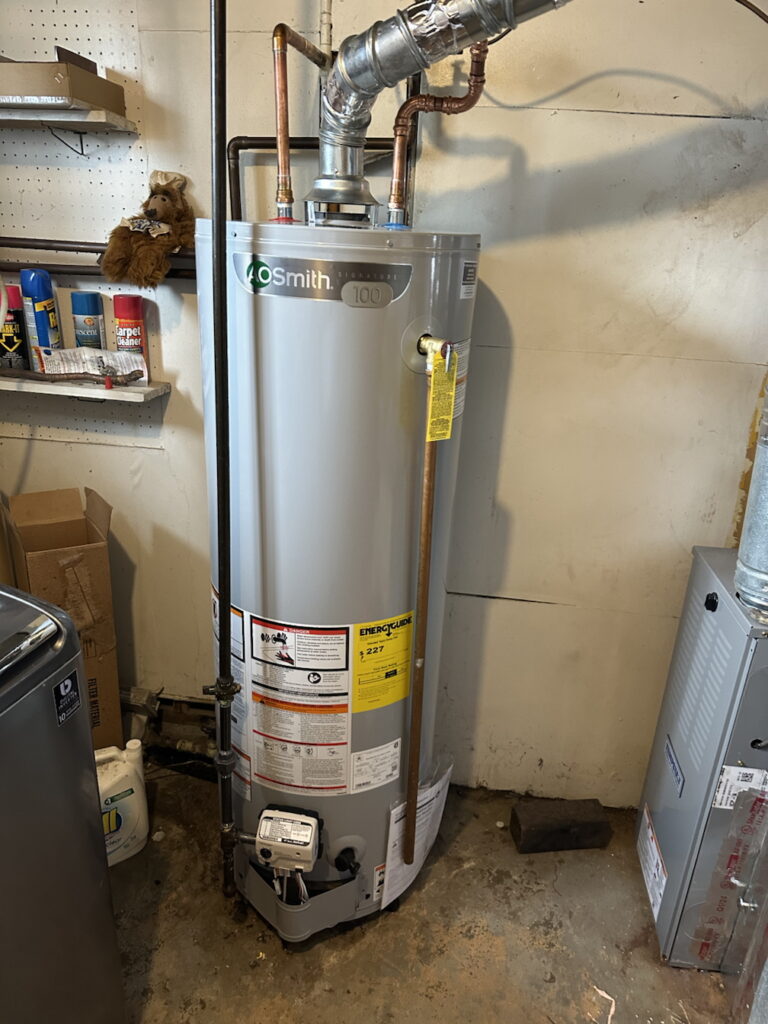
A storage water heater for a single-family home holds 20 to 80 gallons of hot water. When you open a tap, hot water leaves from the top of the tank and cold water flows in at the bottom to be heated. Because the tank keeps that water hot all day, it loses some heat even when nobody’s using it, which is called standby heat loss.
Two parts shape how long a tank lasts. The anode rod is a metal rod (aluminum, magnesium or zinc) that corrodes on purpose so the steel tank doesn’t, and A. O. Smith recommends checking it once a year. Minerals settle on the tank floor as sediment, so most tanks need flushing at least once a year, and more often with hard water.
Tanks are sized by first hour rating, which is how much hot water the heater can deliver in its busiest hour. It should at least match your home’s peak hour demand.
How a Tankless Water Heater Works
When you open a hot tap, cold water flows through the heat exchanger, where a gas burner or electric element heats it on its way to you. With no stored water to keep warm, there’s no standby heat loss.
Here’s the before-and-after. After two long showers, a tank has to refill and reheat from cold. A tankless unit heats each gallon as it passes through, so it keeps going as long as demand stays within its flow rate.
Tank vs Tankless Water Heater Comparison
In short: Tanks win on upfront cost and simple swaps; tankless wins on lifespan, standby energy and space.
Here’s how the two stack up on the points that drive most decisions.
| Factor | Tank water heater | Tankless water heater |
|---|---|---|
| Upfront cost | Lower | Higher |
| Typical lifespan | 10 to 15 years | 20 years or more with proper installation and maintenance |
| Hot water supply | 20 to 80 gallons stored, then a reheat wait | Continuous, at about 2 gallons per minute (electric) to 5 (gas) at a 70°F rise |
| Energy use | Loses heat while idle (standby loss) | No standby loss |
| Yearly upkeep | Flush the tank, check the anode rod | Flush the heat exchanger; softener or scale system in hard water |
| Install work | Often a like-for-like swap | May need gas line, venting or electrical upgrades |
| Space | Needs floor space | Wall-mounted, frees up floor space |
| Power outage | Water already in the tank stays hot for a while | Won’t heat during an outage; gas models need a 120-volt outlet, electric models need dedicated 240-volt circuits |
For Papillion and Omaha homes, two rows usually decide it: upkeep, because of the hard water, and install work, because a switch to tankless can mean new gas piping and venting.
“Endless Hot Water” Still Has a Flow Limit
In short: A tankless unit never runs out, but it can only heat so many gallons per minute, and colder incoming water lowers that number.
A tankless unit’s supply never runs dry, but its output limits how much hot water flows at once. DOE puts typical output at 2 to 5 gallons per minute, with gas models higher than electric, and notes that even the largest gas unit can fall short when several fixtures run at once.
Temperature Rise Sets the Real Number
Tankless units are rated by how much they can raise water temperature at a given flow. The math is your set temperature minus the temperature of the water coming in. At a 120°F setting and DOE’s default assumption of 50°F incoming water, you need a 70°F rise, which DOE says is typically possible at about 5 gallons per minute on gas and 2 on electric.
For scale, a standard showerhead uses 2.5 gallons per minute. Two showers at once ask for about 5 gallons per minute total, with some of that mixed in as cold water.
Colder incoming water lowers the flow a unit can deliver, because it has to add more heat to every gallon. The big number on a spec sheet, such as 11.1 gallons per minute for Rinnai’s RX199iN, is the most the unit can pass when it only needs to warm the water a little.
How Sizing Fixes It
The fix is sizing for your busiest moment and your coldest incoming water. If one unit can’t cover that, a second unit, or a separate one for a high-use appliance, works too, at added cost. Tanks have the opposite limit: plenty of flow at once, but only as much hot water as the tank holds.
Tankless Water Heater vs Traditional: Savings Depend on How Much Hot Water You Use
In short: Tankless gains the most in percentage terms at lower use, but energy savings are one factor alongside sizing, budget and upkeep.
DOE’s numbers show how tankless efficiency gains change with hot water use. They’re one factor in the decision, not the deciding one.
| Household hot water use | How much more efficient tankless is than a storage tank |
|---|---|
| 41 gallons a day or less | 24% to 34% |
| Around 86 gallons a day | 8% to 14% |
A tank’s standby heat loss is a fixed cost of keeping water hot. In a high-use home it’s a smaller slice of the total energy bill for hot water, so removing it saves a smaller share. Over time, longer life and lower operating costs can offset the higher purchase price. For households of any size, peak demand, back-to-back showers, budget and upkeep matter as much as the percentage savings.
Two buying tips help either way. Skip gas tankless models with a standing pilot light, which can waste the energy you’re trying to save, and look for intermittent ignition instead. Then compare the Uniform Energy Factor on the spec sheet, where higher means more efficient. Rinnai’s RX199iN, a condensing tankless model, is rated 0.98.
Gas Line and Venting: What a Switch to Tankless Involves
In short: A gas tankless unit can draw several times the gas of a standard tank and needs the vent type its manual specifies; electric units skip gas and venting but need heavy electrical capacity.
Going from a tank to tankless often means upgrading the gas line, the electrical setup or the venting. Here’s where the differences show up.
| Install item | Standard gas tank | Condensing gas tankless (199,000 Btu model) |
|---|---|---|
| Gas input | 30,000 to 79,999 Btu/hr for a normal-size tank | Up to 199,000 Btu/hr |
| Venting | Same as the old tank in a like-for-like swap | Category IV vent (PVC, CPVC or polypropylene); an older Category I vent may not qualify |
| Extra hookups | Usually none | Condensate drain and a 120-volt outlet |
Why the Gas Line Matters
The gas pipe has to carry enough for the water heater at full fire plus the furnace, dryer and range running at the same time, without the pressure dropping. Rinnai’s manual sizes this by the National Fuel Gas Code and calls for natural gas pressure to stay at or above 5.0 inches of water column with every appliance on. A line sized for a normal tank may be too small for that load.
Why the Vent Changes
A condensing tankless unit needs the vent type its manual lists, and it can’t tie into an existing vent or chimney. That often means a new run through a wall or roof.
Noncondensing gas tankless units usually don’t need a condensate drain, but their hotter exhaust requires the stainless steel or other vent material their manual specifies. Electric tankless units skip gas piping and venting entirely, but whole-home models usually need multiple dedicated 240-volt circuits and sometimes an electrical panel upgrade.
Gas sizing and venting are licensed work. A qualified contractor checks the gas line, vent path and drain spot before quoting and pulls a local permit if one’s needed. Local Plumbing and Drain Company starts every install with an on-site consultation, so the quote reflects what your home needs.
Tankless or Tank Water Heater: Which Fits Your Household?
In short: Either type can serve a household of any size when it’s sized right; the deciding factors are simultaneous demand, back-to-back showers, budget, upkeep and what your gas and venting can handle.
Start with your busiest morning. Then find the row that sounds most like your home.
| Your situation | Better fit | Why |
|---|---|---|
| Several fixtures running at once | Either, sized for peak demand | Tankless needs enough flow at your temperature rise; a tank needs enough first hour rating |
| Back-to-back showers | Either, sized for it | Tankless keeps up as long as flow stays within its rating; a tank needs enough stored water and recovery |
| Old tank failed, budget is tight | Tank | Lower upfront cost, often a like-for-like swap |
| Staying 15 or more years | Tankless with a water plan | Can last 20 years or more with proper installation and maintenance, vs 10 to 15 for a tank; hard water needs treatment |
| Tight utility space | Tankless | Wall-mounted, frees up floor space |
| Undersized gas line or no easy vent path | Tank, unless upgrades are budgeted | Gas tankless can draw up to 199,000 Btu/hr and needs its own vent |
| All-electric home | Compare output closely | Electric tankless gives about 2 gallons per minute at a 70°F rise |
That last row is where the electric tankless water heater vs tank question gets decided: check the unit’s flow at your temperature rise before ruling a tank in or out.
Most homes match more than one row. Sorting out which one wins is what an on-site visit is for.
Tankless vs Tank Water Heater Cost in 2026: Credits and Financing
In short: Tankless costs more up front, the federal tax credit ended after 2025, and financing can spread the difference.
A. O. Smith publishes these national equipment price ranges. Installed pricing depends on the equipment, gas piping, venting, water treatment and permit requirements, and Local Plumbing and Drain Company provides an estimate after evaluating the home.
| Cost item | Tank water heater | Tankless water heater |
|---|---|---|
| Unit | About $300 to $2,000 | About $1,000 to $3,000 |
| Installation | Depends on gas piping, venting, water treatment and permits; estimated on site | Depends on gas piping, venting, water treatment and permits; estimated on site |
The Federal Tax Credit Ended After 2025
Some guides still mention a federal tax credit for efficient water heaters. The IRS says the energy efficient home improvement credit can’t be claimed for property placed in service after December 31, 2025. For a 2026 install, budget without it.
Local Rebates
M.U.D.’s current residential rebates cover gas ranges, gas dryers and rain sensors, with no water heater rebate listed. If your gas comes from Black Hills Energy, its Nebraska HEAT program form lists a $300 rebate for tankless units with a UEF of 0.81 or higher.
Financing and Estimates
Local Plumbing and Drain Company offers financing to help spread out the cost. It also honors every upfront estimate. Over the years, lower energy use on tankless chips away at the price gap, most of all in lower-use homes.
Tankless vs Tank Water Heater FAQ
In short: Seven quick answers on lifespan, local water, flushing, flow, gas lines, instant hot water and tax credits.
How long does a tankless water heater last compared with a tank?
A tankless unit can last 20 years or more with proper installation and maintenance, while storage tanks typically last 10 to 15. In hard water, reaching that range depends on a softener or scale system and a yearly flush of the heat exchanger.
Is Papillion water too hard for a tankless water heater?
No, but it needs treatment. Papillion’s city water is 13 grains per gallon, about 220 mg/L, which falls in the top band of Rinnai’s hardness table, where a softener or scale system is required.
How often should a tankless water heater be flushed?
Rinnai’s manual lists once a year for homes. Some units can show a Service Soon code when a flush is due, and scale builds faster at higher temperature settings.
Can a tankless water heater run two showers at once?
Often, if it’s sized for it. A standard showerhead uses 2.5 gallons per minute, and a gas unit typically manages about 5 gallons per minute at a 70°F rise, less when incoming water is colder.
Do I need a bigger gas line for a tankless water heater?
Often, yes. A 199,000 Btu tankless unit can draw several times what a normal 30,000 to 79,999 Btu/hr tank uses, and the line has to feed every gas appliance at once without losing pressure.
Does a tankless water heater give you instant hot water?
No. It starts heating as soon as you open the tap, but the water still has to travel through your pipes, so far-off fixtures wait the same way they do with a tank. Some tankless models include a built-in recirculation pump to shorten that wait.
Is there a federal tax credit for a tankless water heater in 2026?
No. The IRS says the energy efficient home improvement credit can’t be claimed for property placed in service after December 31, 2025.
Get the Right Water Heater for Your Papillion Home
In short: The right pick comes down to your busiest morning, your gas and vent setup, and your water.
Tank or tankless, the right choice depends on how much hot water your home uses at once, what your gas line and venting can support, and how hard your water is. Local Plumbing and Drain Company installs and services both, along with water softeners, and starts with an on-site visit to size the heater, check the gas and vent path, and set a water plan.
If your water heater has stopped working, start with what to do when your water heater stops making hot water. When you’re ready, request an appointment, call 402-590-8111, or stop by 705 N Frontier Rd, Papillion, NE 68046.
Sources
- U.S. Department of Energy, Energy Saver, Tankless or Demand-Type Water Heaters. https://www.energy.gov/energysaver/tankless-or-demand-type-water-heaters
- City of Papillion, Water Hardness. https://www.papillion.gov/437/Water-Hardness
- Metropolitan Utilities District, Your Water. https://www.mudomaha.com/your-water/
- Rinnai, SENSEI RX Residential Installation and Operation Manual (100000839). https://media.rinnai.us/salsify_asset/s-5dcde422-3307-426c-ab15-29ecd56cac15/100000839%20SENSEI%20RX%20Residential%20Installation%20and%20Operation%20Manual.pdf
- U.S. Department of Energy, Energy Saver, Storage Water Heaters. https://www.energy.gov/energysaver/storage-water-heaters
- A. O. Smith, Water Heater Maintenance. https://www.hotwater.com/info-center/water-heater-maintenance.html
- U.S. Department of Energy, Energy Saver, Sizing a New Water Heater. https://www.energy.gov/energysaver/sizing-new-water-heater
- A. O. Smith, Tankless Water Heater vs Standard Tank: Which Is Best for You?. https://www.hotwater.com/info-center/tankless-vs-tank-water-heaters.html
- U.S. Environmental Protection Agency, WaterSense, Showerheads. https://www.epa.gov/watersense/showerheads
- Orange County Health Care Agency, Guidelines for Sizing Water Heaters. https://www.ochealthinfo.com/sites/hca/files/2021-06/Water_Heater_Guidelines_Updated_2-6-2020.pdf
- Rinnai, RX199iN product page. https://rinnai.us/residential/product-detail/rx199in
- Black Hills Energy, Nebraska HEAT Program Water Heater Rebate Form. https://www.blackhillsenergy.com/form/nebraska-water-heater-rebate-cla
- Internal Revenue Service, Instructions for Form 5695 (2025). https://www.irs.gov/instructions/i5695
- Metropolitan Utilities District, Rebates. https://www.mudomaha.com/rebates/